
At Indemo, we believe that investing becomes more meaningful when investors understand what is happening behind the numbers.
Earlier this year, we shared our 2026 roadmap with the community, outlining our focus on real liquidity, clearer exit opportunities, and a more dynamic investment experience. Dynamic portfolio revaluation is another important step in that direction.
Mortgage NPL as a asset class is not static. Property values can change over time due to market conditions, asset-specific developments, debt recovery progress dynamics, and updated collateral data.
That is why Indemo has introduced dynamic investor portfolio revaluation, a new platform feature designed to help investors better understand how the indicative value of their portfolio may evolve over time and how this influences their potential personal returns.
Instead of showing each investment only through the original purchase parameters, the platform can now reflect updated asset-level data and broader real estate market dynamics. This gives investors a more current and transparent view of how their real estate-backed investments develop throughout the investment lifecycle.
The indicative portfolio value is not a guaranteed sale price, investment advice, or a promise of future return. It is an informational reference point that helps investors better understand the current estimated position of their portfolio and get better prepared for a healthy and credible secondary market launch coming later this year. As well as adding the right debt trading and pricing logics.
Why dynamic revaluation matters
When an investor purchases a share in a mortgage NPL, the opportunity is usually assessed based on the data available at that moment. This includes the purchase price, collateral value, debt amount, recovery stage and other key investment indicators like Price-to-Value and Price-to-Debt.
However, the picture changes after the investment is made.
The property market may move. The estimated collateral value may increase or decrease. New asset-level information may become available. The outstanding debt amount may also change as the case progresses.
Until now, investors could only compare their current portfolio with the original purchase view. The only dynamic parameter investors were tracking was the foreclosure (legal proceeding) progress through the Flow stages and steps. With dynamic revaluation, Indemo makes this view more up to date.
This matters because real estate-backed debt is connected to real assets. Those assets exist in a changing market, and we believe investors should be able to see that movement reflected in a clear, structured, and easy-to-understand way. The model used for building the revaluation on Indemo is taken from the debt institutional secondary market directly into the investor experience. It also aligns our valuation and pricing logic with how institutional NPL buyers and sellers operate in the Spanish market — where disciplined, model-based pricing and stage-based assumptions are standard practice.
What has changed for investors
The investor portfolio is no longer displayed only through historical transaction data.
Indemo now shows the indicative portfolio value with the revaluation of underlying assets taken into account. This helps investors better understand:
- how the estimated value of the real estate collateral may change over time;
- how the relationship between their position price and the current collateral value evolves;
- how updated debt and collateral information can influence portfolio indicators and potential earning and returns;
- how their portfolio develops beyond the original investment date;
- properly setting the buy or sale price for lots on the upcoming secondary market.
The result is a more dynamic portfolio view. Instead of seeing only a fixed snapshot from the moment of purchase, investors can follow a portfolio that better reflects the nature of discounted mortgage NPLs as an asset class.
This brings the user experience closer to how professional real estate and debt investors monitor assets: not as static entries, but as positions that should be followed, updated, and assessed over time.
How this looks on the platform
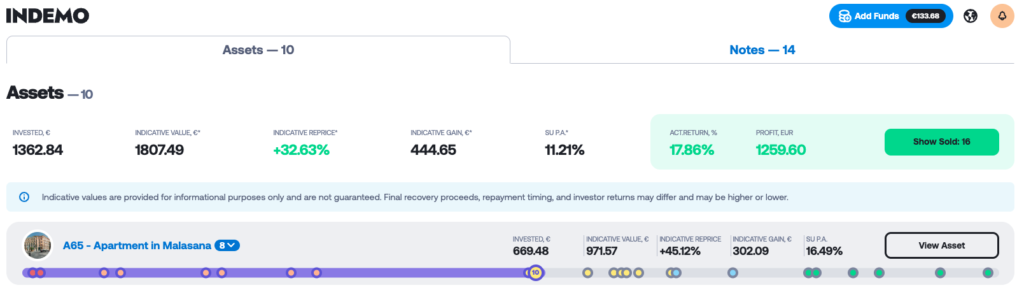
Investors can view the updated portfolio indicators directly in the Assets section of the Portfolio in their Indemo account.
To see them, go to My Assets:
There, investors can already see key portfolio figures such as:

Actual return
The annualised return generated by the investment through the closed cases so far.
Invested
Platform definition: The total amount of capital initially committed to the Investment. This figure represents the principal sum placed into the investment, not including any subsequent profits or Interest accrued.

In plain English: This is the amount you originally invested, before any returns or interest are added.
With dynamic portfolio revaluation, several new indicators have also been added to help investors better understand how their portfolio value may evolve over time.
Indicative Value*
Platform definition: Estimated current value of the asset(-s) based on the revaluation model. Final recovery or sale proceeds may be higher or lower.
In plain English: This shows the current indicative value of your current assets based on the repricing model and helps you compare it with the amount you originally invested in them. This is reflected both for the whole active portfolio and for each asset in your portfolio individually.
Indicative Reprice*
Platform definition: Estimated percentage change in the asset’s indicative value based on Indemo’s revaluation model. This is not a guaranteed return or exit price.
In plain English: This shows how much the indicative value of your current assets has changed in percentage terms compared with its original acquisition price. This is reflected both for the whole active portfolio and for each asset in your portfolio individually.

Indicative Gain*
Platform definition: Estimated potential gain based on the current indicative value compared with the invested amount. This is not realised profit and is not guaranteed.
In plain English: This shows the potential gain you may earn if the debt is recovered (closed) now, based on the current repriced market value, but it is not yet a realised return. This is reflected both for the whole active portfolio and for each asset in your portfolio individually.
Stage Uplift p.a.*
Stage Uplift is an indicative annualised growth driven by the asset’s recovery stage progress. It may be achieved through a quick sale on the upcoming Secondary Market. Final returns from the underlying debt recovery process or real estate sale may differ and may be higher.
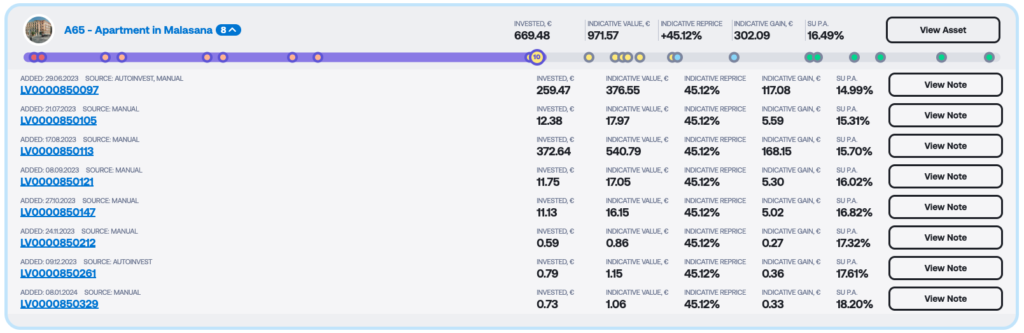
These indicators are designed to give investors a clearer and more practical view of their actual portfolio directly inside the platform. They do not represent a guaranteed exit price, promised return, or investment advice. Instead, they provide an informational reference point to help investors better understand how their real estate-backed investments may develop over time.
How the revaluation works - The Model
The new feature supports three main revaluation scenarios.
1. Real-time daily automatic revaluation
For this model, Indemo uses data on annual Spanish real estate market dynamics from verified external sources. This annual figure is then converted into a daily adjustment coefficient, allowing the platform to reflect gradual market movement in the indicative portfolio value.
In simple terms, the platform does not wait for a manual update to show that the market has changed. Instead, the annual market dynamics indicator is translated into a daily adjustment model, helping investors see indicative value changes gradually over time.
This does not mean that each individual property receives a new independent appraisal every day. Rather, it is a market-based model designed to reflect broader real estate dynamics in a structured and transparent way.
The model also takes into account the annual increase of the creditor claim amount. During an ongoing mortgage foreclosure process, the claim amount may increase due to accrued penalty interest, court costs, legal fees, and other recovery-related expenses. Based on the long-standing experience of Indemo’s cooperation partners in the Spanish mortgage lending and debt recovery market, the claim amount is assumed to increase by approximately 5% per year on average. This assumption is also reflected in the revaluation model.
2. Manual revaluation based on updated asset data
When Indemo receives new information from servicing partners conducting due diligence or periodic asset-level reviews, the platform can update key parameters for a specific asset. This may include the current collateral value, the claim/debt amount (usually recalculated and recorded by the legal team on a monthly basis), and related indicators.
Manual revaluation takes priority over the automatic model because it is based on more precise information about a specific asset.
In practice, this means that the automatic model reflects general market dynamics, while manual updates allow more accurate asset-level data to be included when it becomes available.
Together, these two scenarios create a more complete revaluation framework: one part reflects market movement, while the other reflects updated information about individual assets.
3. Recovery Stage Progress and Time-to-Exit Adjustment
The third attribute reflected in the revaluation model is the reduced expected time to exit as a debt progresses through the Recovery Flow.
As a debt moves through the Recovery Flow and successfully passes some of the most lengthy and complex stages — such as subrogation, opposition, or appeal — the remaining path to one of the potential exit scenarios becomes shorter. This reduced remaining duration is an important value driver, as it may improve the expected timing of recovery and influence yield expectations.
Therefore, as a case advances through the Recovery Flow and the remaining expected time to exit decreases, this progress influences the indicative revaluation of the position, while also adjusting the attributes described in items 1 and 2.
Data from verified external sources
For automatic revaluation, Indemo does not rely on arbitrary internal assumptions. The model is connected to verified external sources that reflect residential and housing real estate market dynamics.
These may include official statistical data, market indices, public reports, and information from specialized organizations. This helps ensure that changes in the indicative portfolio value are linked to observable market data rather than subjective internal judgement.
One relevant reference point for the Spanish real estate market is the Instituto Nacional de Estadística, INE, Spain’s official statistics institute. INE publishes the Housing Price Index, or Índice de Precios de Vivienda, which measures changes in housing prices in Spain for both new and second-hand dwellings. The second-hand dwelling segment is especially relevant for existing residential properties, which are the dominant type of collateral connected to Indemo investment opportunities.
According to INE, the Housing Price Index measures the evolution of sale prices of free-priced homes over time, using transaction price information from deeded homes provided by the General Council of Notaries.
Indemo uses such sources as part of a broader methodology for assessing real estate market dynamics. This makes the revaluation more transparent, explainable, and connected to independent data.
A more realistic view of mortgage NPL investing
The launch of dynamic portfolio revaluation strengthens transparency on the Indemo platform.
For investors, the main benefit is simple: the portfolio becomes easier to understand as it develops.
Investors can now see not only how much they originally invested, but also how the indicative value of their portfolio may change as market data and asset-level information are updated.
This is especially important in real estate-backed debt investing. Collateral value, debt amount, market movement, and recovery progress all influence how a position should be understood.
With dynamic revaluation, investors gain a more complete view of these relationships.
What this gives investors
A more up-to-date portfolio view
Investors can see that real estate, as the underlying asset, may change in value after the purchase date. This helps move the portfolio experience away from a static historical view and toward a more current asset-based view.
Clearer logic behind value changes
The revaluation is based on market data and updated asset-level information. This means changes are not arbitrary. They are connected either to broader market dynamics or to more precise updated information about a specific asset.
A more professional investment experience
Professional real estate and debt investors monitor assets over time. They do not only look at the original purchase date. Dynamic revaluation brings this same logic into the Indemo platform, helping investors follow their portfolio in a more informed and structured way.
A new step in Indemo’s platform development
Dynamic portfolio revaluation is an important product milestone for Indemo. It reflects the platform’s broader direction: combining access to an institutional-style real estate-backed asset class with a modern fintech experience.
Indemo simplifies many parts of real estate-backed debt investing for individual investors. At the same time, the platform continues to add more data, context, and transparency around how each portfolio develops. With this new feature, investors can follow their portfolio in a more dynamic way, supported by external market data and updated asset-level information.
The goal is not to predict the final outcome of every investment. The goal is to give investors a clearer, more transparent, and more realistic view of the assets behind their portfolio.
Important note
The indicative portfolio value, unrealised gain, stage uplift, and other revaluation data displayed on the Indemo platform are provided for informational purposes only.
These values are based on a revaluation model that uses external market data, updated asset-level information, and certain assumptions. The model may be incomplete, may contain errors, and may not fully reflect all legal, market, asset-specific, timing, or recovery-related factors relevant to an individual case.
The indicative value does not represent a guaranteed sale price, guaranteed recovery amount, investment advice, or a promise of future return. The final debt recovery proceeds, exit value, investor gains, and timing of repayment may differ materially from the indicative values shown on the platform and may be either higher or lower.
Actual outcomes depend on a variety of factors, including the legal recovery stage, court proceedings, debtor settlement, auction results, secondary market demand, collateral condition, property market dynamics, servicing strategy, recovery costs, and other case-specific circumstances.
Download the Indemo app 📱
Our mobile app is now available on the App Store and Google Play, making it easier to stay connected to your portfolio wherever you are.
Download IOS (App Store) | Download Android (Google Play)
Check out Indemo’s Key Socials:
📢 Telegram - Exclusive Indemo Community Chat featuring key Indemo stakeholders
📷 Instagram- Weekly content, meet the team, weekly stories
🎥 YouTube - Podcasts, expert insights, and quarterly reviews
This content is a marketing communication. It shall not be treated as investment advice, independent research or offer, recommendation or invitation to invest in the investment opportunities referred to herein. The content is not aimed at promoting services or products to persons based in jurisdictions where the distribution of said information would be illegal.
Investing in financial instruments involves risk, and there’s no guarantee that investors will get back invested capital. Moreover, past performance does not guarantee future returns. Indemo SIA shall not be responsible for any direct or indirect loss from using the provided information.